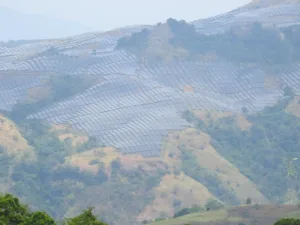

On the day of Ferdinand Marcos Jr’s State of the Nation Address on July 28, the Unyon ng mga Manggagawa sa Agrikultura (Union of Agricultural Workers, or UMA) denounced the continuous expansion of commercial plantations in Mindanao and Negros while agricultural workers are mired in misery. These plantations focus on production for exports instead of strengthening local food production.
The regime’s latest measure include leasing 226.4 hectares of land within the Phividec economic zone in Misamis Oriental for the “temporary use” of Del Monte Phils (DMP) this July. The land owned by Phividec was categorized for industrial use rather than agricultural, and thus, exempted from distribution. Located in the towns of Tagoloan and Villanueva, these lands have long been idle, with the Phividec holding it “hostage” and denied to farmers.
DMP is owned by the Campos family, which controls “the world’s largest pineapple plantation,” now covering 30,000 hectares, according to the UMA. These thousands of hectares are spread across Bukidnon and Misamis Oriental, where the minimum wage of agricultural workers is ₱461 per day. This amount is only 38% of the needed minimum living wage of ₱1,200.
Another regime’s measure allowed the expansion of Itochu Corp’s banana plantation in Polomoloc, South Cotabato. The minimum wage there is ₱420, only 35% of the living wage.
In Negros, UMA refuted the Hacienda Asia Plantation Inc. (HAPI)’s claim that the Consunji family’s proposed oil palm plantation will create 500 jobs. This plantation’s workers will only earn ₱488 per day, and their contracts lack clear provisions for SSS, Philhealth, and Pag-ibig benefits. “There is not even a provision holding the company accountable for work-related injuries, illness, or death,” according to UMA.
Apart from these, expansion of commercial plantations is also planned for coffee (SOCCSKSARGEN, Davao, BARMM); mango (Pangasinan, Isabela, Pampanga, Cebu City, Zamboanga City); commercial timber, abaca, and bamboo (Lanao del Sur, Western Visayas). Meanwhile, the area allocated for the production of rice, vegetables, and other food products is shrinking due to the widespread conversion of land for real estate, and grandiose and foreign-oriented infrastructure.