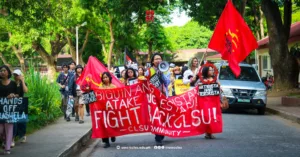

Fisherfolk expressed distress and anxiety over the US plan to “rehabilitate” the Sangley Point International Airport (SPIA) in Cavite City, a civilian airport, to include it in its proposed Luzon Economic Corridor. In a statement, the Pambansang Lakas ng Kilusang Mamamalakaya ng Pilipinas (Pamalakaya, or National Strength of the Fisherfolk Movement in the Philippines) condemned the said plan.
The US Trade and Development Agency (USTDA) announced on May 12 that it will fund a feasibility study to transform the airport into a dual-use facility for civilian and military purposes. Sangley Point was formerly a US Navy base. The US returned it to the Philippine state as early as 1971.
The US will partner with Cavitex Holdings Inc. (CHI) for the construction and the S-A-P Group to carry out the study. CHI is owned by the Viratas, a family close to the Marcoses. One of the Viratas, Cesar Virata served as prime minister of the US-Marcos Sr dictatorship. The S-A-P Group is an aviation consulting firm based in San Francisco, California.
The US plans to use Sangley Point for direct flights from major US airports. It will use American technologies such as scanners, radar, and telecommunications systems to ensure US control. Sangley Point has a distinct strategic position at the mouth of Manila Bay. It is close to Metro Manila while having a direct route to the South China Sea. The US is preparing the airport so it can quickly adapt as a forward operating base for troops and military equipment.
“We are not ignorant to the sinister agenda of the US in funding the rehabilitation and ultimate transformation of the SPIA,” Pamalakaya national chairperson Fernando Hicap said in a May 31 statement. He said that the US has the same objective for SPIA as that of the construction of military facilities in at least nine EDCA sites nationwide.
Hicap called on Filipinos to remain vigilant against the covert and overt intervention of foreign military forces in the disguised rehabilitation of a civilian facility.
Meanwhile, the Pamalakaya chapter in Cavite expressed fear that US military activities at SPIA will severely impact their livelihood and security. “We cannot remain calm with an American facility near our fishing grounds, all the more with an American military base,” Pamalakaya-Cavite president Richard Catenza said.
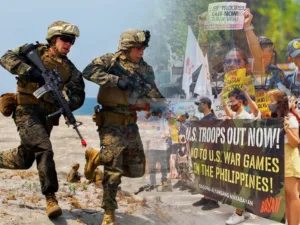
He said fisherfolk have many experiences of disruption in their livelihood whenever American soldiers conduct activities in seas and coastlines. The most recent of these was the imposition of a ‘no sail zone’ in Zambales from May 28-30 to give way to US-PH war games and earlier in April for Balikatan 2026.
“This must be opposed not only by the Manila Bay fisherfolk, but by coastal residents who may get trapped in whatever conflict the US is involved in,” Catenza urged. He challenged the local governments of Cavite to speak out against the presence of US military troops and war materiel in SPIA and the province. “They must express concern and monitor this foreign interventionist plan of managing and operating a public facility.”