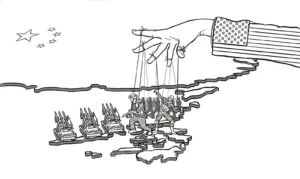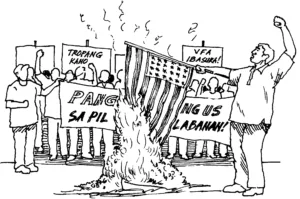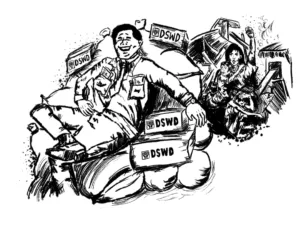
A few days before Ferdinand Marcos Jr’s fourth State of the Nation Address, on July 20–22, US president Donald Trump summoned him for “negotiations” on the tariff levels on products from the Philippines and other economic and military concessions. Like a loyal minion, Marcos offered the country’s freedom and sovereignty to his imperialist master.
Marcos agreed to fully remove tariffs on American products. He portrayed the so-called “zero tariffs” as a “concession” given in exchange for Trump’s 1% reduction of tariffs imposed on Philippine exports, from 20% to 19%. The regime also tried to downplay the impact of “zero tariffs” on Philippine exports and claimed that the country would lose only $3-$6 billion in revenue from this.
In fact, Marcos gained nothing from lowering tariffs. Before Trump’s second term, tariffs only ranged 2%-3.6%. Trump raised tariffs on all US imports to 10% when he took office. In April, he set a “reciprocal tariff” of 20% on major agricultural products the Philippines exports to the US such as coconut, fruits, and sugar. As before, additional tariffs will not be imposed on products like semiconductors, manufactured for American companies in the Philippines.
On the other hand, Marcos further opened the local economy for dumping US surplus products like cars, soy, wheat, and pharmaceuticals. From these products alone, the state is estimated to lose up to ₱3.9 billion in revenue. The Ibon Foundation estimates that total Philippine revenue loss could reach ₱31-₱35 billion annually if other US exports to the country are included.
The Philippines is one of the biggest dumping ground for US agricultural products in Southeast Asia and ranks 8th worldwide. US exports to the Philippines include meat and processed vegetables, which will certainly pull down the production and value of local products. Meanwhile, the influx of these imported goods will further weaken the country’s capacity to manufacture and produce for domestic needs.
Military concession
Marcos also surrendered Philippine freedom to Trump by granting more incentives and concessions to American companies to set up factories and operations in the country. These include Cerberus, I Square Capital, KKR & Co, and Global Infrastructure Partners, companies set to invest in shipbuilding, logistics, and energy to support the expansion of the US market and military presence in the Philippines and Asia. The US promised to pour up to $3 billion in funds to the Philippines, but these funds are for American companies investing in the so-called Luzon Economic Corridor.
Even before the July visit, Marcos was busy providing additional locations to serve as US military bases. Most recent is his offer of the western coast of Davao Gulf (covering Davao City, Davao del Sur, and Malalag Bay) to build a “fuel depot” that will store 159 million liters of diesel annually for large US warships. This will supply fuel to both warships and warplanes operating in the Sulu and Celebes seas. This fuel depot will replace the major US military depot in Hawaii, permanently closed in 2022 due to leaks that contaminated drinking water for nearby communities.
Before this, Marcos had already opened Subic for manufacturing ammunition, bombs, and other materiel; the islands of Grande and Chiquita near the Subic coast for additional American surveillance bases; and most of the northern coast and seas of Palawan, including Oyster Bay, as a base and shipyard for US warships.