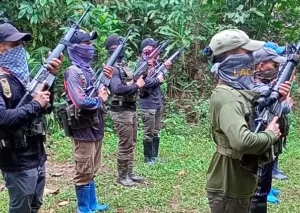

The New People’s Army (NPA)-Mindoro (Lucio de Guzman Command) condemned the 1st IB and 203rd IBde for the willful killing of an hors de combat Red fighter on August 7. The butcher soldiers captured Ising Domingo (Ka Mutya) in Barangay Happy Valley, Roxas, Oriental Mindoro, tortured her, and willfully killed her.
The NPA-Mindoro reported that Ka Mutya was unarmed and alone when the 1st IB caught her at around 1:00 p.m. that day. She was fetching water while her unit was deployed for an investigative mission to assess the situation of farmers in the barrio.
They subjected Ka Mutya to intense torture and killed her after refusing to give information or cooperate. This was also the 1st IB’s vengeful act after Ka Mutya’s fellow fighter, Jomari Palomar (Ka Jonnel), fired at soldiers while searching for her. Ka Jonnel was martyred in the battle.
The 1st IB’s torture and killing of Ka Mutya is a grave violation of the rules of international humanitarian law. As an opposing armed force already holding Ka Mutya captive, the soldiers had a duty to ensure their held prisoner’s safety.
“The commanders of the 1st IB, the 203rd IBde, and the AFP commander-in-chief Ferdinand Marcos Jr, bear direct culpability. Marcos Jr and the entire AFP must be exposed and denounced for implementing the ‘take no prisoners’ policy in their bloody war against the revolution and the Filipino people,” NPA-Mindoro spokesperson Ka Madaay Gasic said.
The spokesperson added that this further exposes the Armed Forces of the Philippines’ extreme fascism and rottenness. “It further proves the validity and correctness of taking up arms against the reactionary government to defend against its oppression, and of advancing the armed revolution to achieve genuine justice and peace,” he said.
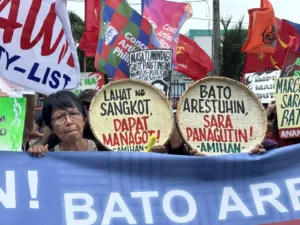
In connection with the recorded human rights and international humanitarian law violations, Karapatan-Southern Tagalog launched an independent fact-finding mission in Roxas. State forces have been harassing the Karapatan team in Roxas Since August 9.
Soldiers harassed the team’s peaceful protest and picket in front of the funeral home where the remains of those killed were laid. Later, 203rd IBde soldiers reportedly stole and took the remains of Ka Jonnel and Ka Mutya in the middle of the night.
“We demand an immediate and independent investigation into the August 7 military operation, the unlawful removal of the victims’ remains, and the systematic intimidation of the fact-finding team. We call for the withdrawal of military forces from civilian communities, the restoration of civilian authority, and urgent protection for the Mangyan people and all vulnerable sectors in Roxas,” Karapatan-Southern Tagalog paralegal Ida Palo said.
Meanwhile, NPA-Mindoro honored the its two fighters’ martyrdom. “NPA-Mindoro extends a Red salute and the highest tribute to the… good sons and daughters of the people, Red fighters and the true army of the peasant class, heroes of the Mindoreño masses and all the oppressed Filipino masses,” Ka Madaay said.
Ka Mutya, 30, was a recent full-time fighter from the Mangyan-Hanunuo indigenous community in Barangay Paclolo, Magsaysay, Occidental Mindoro. According to the NPA-Mindoro, Ka Mutya experienced harrasment to force her illegal “surrender.” The fascists made treated her like a slave, forced her to work in a fishpond without pay for a month, and frequently beat her. In the NPA, she served as the her squad’s logistics officer and was a key partner in surveying and studying the terrain and areas she knew well.
Ka Jonnel, 26, came from a poor peasant family in the Visayas. As a Red fighter, he unhesitatingly accepted any task or assignment. He carried out key duties in expansion work, particularly in connecting with new and reactivated masses, discovering new routes and bases, and consolidating the mass base during intense enemy psywar. This elevated Ka Jonnel to the level of field Party cadre and squad leader.
“The martyrdom of Ka Jonnel and Ka Mutya is both a challenge and an inspiration, especially to young peasants and indigenous people. Their lives and struggle prove that the rightful place of the toiling masses—especially peasants and indigenous people, who are the most oppressed in a semi-colonial and semi-feudal society—is in the people’s democratic revolution,” Ka Madaay said.