

For majority of Filipinos, the worsening crisis of the semicolonial and semifeudal ruling system is marked by the unbearable weight of soaring prices of basic goods and services, stagnant wages, and widespread landlessness. Following the US imperialist war on Iran and the compounding impacts of oil price hikes, Filipino families already struggling to make ends meet are forced even further to stretch their shrinking incomes as they shoulder the burden of a crisis they did not create.
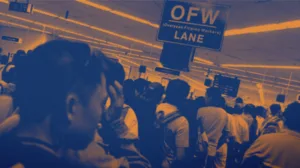
The resulting increase in fuel costs has exposed once more the chronic backwardness and dependence of the Philippine economy. Decades of neoliberal policies imposed by foreign monopoly capital and faithfully implemented by successive reactionary regimes have left the country without a national industrial base, heavily dependent on imported fuel, imported goods, foreign loans, and remittances from overseas Filipino workers.
As oil prices soar, the burden is immediately passed on to the Filipino people. The giant oil corporations, protected by the Oil Deregulation Law and operating as a cartel, continue to rake in enormous profits while imposing weekly price hikes on diesel, gasoline, and kerosene. Even with the rollback of oil prices in the global market, Filipino consumers have yet to experience any meaningful relief. Recent fuel rollbacks merely clawed back a tiny fraction of the massive increases imposed during the height of the crisis. Diesel and gasoline prices remain substantially higher than they were before the US-instigated war on Iran disrupted the energy market, while the inflationary effects of previous increases continue to burden the people.
In the countryside, the crisis is equally severe. Landlessness remains widespread despite decades of agrarian reform promises. Farmers face rising production costs, cheap imported agricultural products, and declining incomes. Fisherfolk confront higher fuel expenses, dwindling catches and anti-people policies that prevent them from earning a livelihood in the sea in favor of big fishing vessels. Rural communities continue to be displaced by mining operations, big plantations, so-called “renewable energy” projects, and increasing land speculation and conversions. The country’s vast natural resources remain under the control of foreign monopoly capital and their local comprador and landlord partners, while the people who produce the nation’s wealth and food remain unacceptably impoverished.
While the basic masses struggle to survive on a daily basis, the political rivalry among competing factions of the ruling class grow even deeper, further exposing the rotten state of the current ruling system. Last February, the House of Representatives impeached GRP Vice President Sara Duterte over her misuse of public funds among other allegations, while the Marcos faction moved to consolidate power and weaken their political rivals ahead of the 2028 presidential elections. In response to this attack, the pro-Duterte faction in Senate deposed thesitting Senate President, and installed Allan Peter Cayetano as the new Senate President to block impeachment attempts against Sara Duterte.
In the midst of this political circus, the ICC warrant against Senator Bato Dela Rosa was declassified on May 11, and instead of surrendering him to the court, the newly installed pro-Duterte majority conducted a ruse that would eventually allow him to escape. Since then, the intensifying Marcos-Duterte divide within the Senate has spurred widespread public frustration among the Filipino masses leading to broader calls for accountability and genuine change.
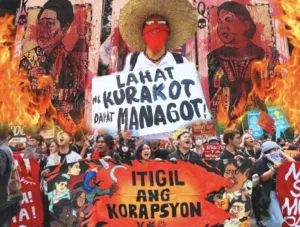
Revelations surrounding anomalous flood-control projects, infrastructure contracts, and other “farm-to-pocket” schemes have further exposed that public office has become a vehicle for personal enrichment among bureaucrat-capitalists. The anger of the people is particularly intense because these corruption scandals unfold amid repeated floods, landslides, and other disasters that devastate communities lacking adequate protection and support.
The Filipino people rightly demand accountability from both the Marcos and Duterte camps. Yet they also recognize that the ongoing political drama of the Marcoses and the Dutertes is fundamentally a struggle among rival factions of the same ruling classes. Neither side offers a solution to the poverty that they experience everyday, the hopelessness caused by rampant unemployment, landlessness and the endless cycle of debt, the brazen corruption, and outright disregard of the country’s sovereignty.
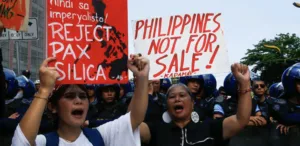
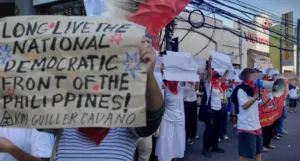
As the economic and political crises deepen, the Marcos regime has increasingly relied on repression of all forms of dissent and relentless militarization in the countryside. Student protests, transport strikes, anti-corruption mobilizations, and anti-imperialist demonstrations have been met with surveillance, intimidation, red-tagging, arrests and threats. Military and police forces continue to be deployed against communities, workers, peasants, and indigenous peoples asserting their democratic rights.
The US-Marcos regime has increasingly weaponized the institutions of the state. In addition to its primary fascist instruments in the form of the NTF-Elcac, the AFP and the PNP, it has used laws, courts and civilian agencies to criminalize dissent and portray all forms of resistance, including revolutionary forces as “terrorists” or “obstacles to development.”
The regime’s repressive posture is closely linked to its unquestionable subservience to US imperialism. While the people suffer, the Marcos regime has enthusiastically opened the country to an expanding US military presence. Through the Enhanced Defense Cooperation Agreement (EDCA), and multiple Status of Visiting Forces Agreements, multiple military sites have been made available to ever-growing US forces on Philippine soil. Massive Balikatan and Salaknibexercises have become annual demonstrations of military trainings between the fascist Armed Forces of the Philippines and the US military.
The AFP continues to receive millions of dollars of funding, weapons, intelligence support, and training from the US to secure the interests of US imperialism in the region.
The same military forces trained through these programs are deployed against peasant communities resisting land grabbing, against indigenous peoples defending ancestral lands, against workers organizing unions, and against the revolutionary forces of the New People’s Army fighting for national and social liberation. The intensified counterrevolutionary campaign, marked by military occupation of villages, bombings, blockades, extrajudicial killings, abductions, and other grave violations human rights and international humanitarian law, serves both domestic reaction and foreign imperialist interests.
As the ruling classes intensify their competition for power and wealth, the Filipino people are increasingly recognizing the necessity of revolutionary change as the only means to end US imperialist control, feudal exploitation, and the scourge of bureaucrat capitalism.