
Over a month into the US war of aggression against Iran, oil prices remain high in the international and local markets. This despite Iran’s slight easing of the Strait of Hormuz passage for oil tankers bound for “non-hostile” countries, as well as the easing of US sanctions on Russian oil.
Crude oil prices steadily rose up to 60% since the US first bombed Iran. This resulted mainly from market speculation by finance companies, where future supply is traded (called futures). Crude oil prices hit $109/barrel in the market on April 2, up from $65-$70/barrel before February 28.
Research has shown that crude oil costs only $42/barrel to produce, while producers charge $16 in royalties or taxes. Speculators and oil companies thus amassed $72/barrel in profit when petroleum prices peaked at $130/barrel in the world market. The major speculators in the market are the same investors in the world’s monopoly oil companies. Only five companies– ExxonMobil (US), Chevron (US), BP or British Petroleum (UK), Shell (UK/The Netherlands) and Total (France)–hold the monopoly on pricing in the global oil supply.
Philippine oil companies worsened the monopoly pricing by imposing “replacement cost” or added prices on oil bought before the war to allegedly cover higher future purchase prices. When global crude oil prices rose by 25%–38% in the first week of March, oil companies in the Philippines increased local oil prices by 43%–50%, despite selling oil stocks purchased before March. This is allowed under the deregulated oil industry which gives companies complete freedom to set selling prices regardless of fluctuations in the global market.
Transport freeze, strike
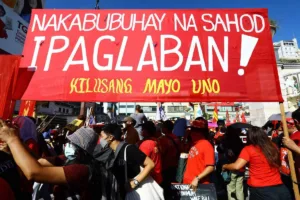
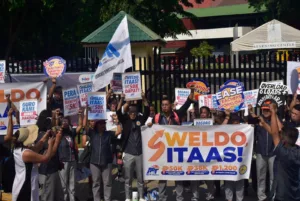
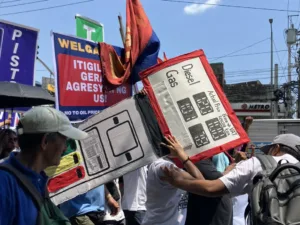
Thousands of jeepney, bus, UV Express, TNVS, and motorcycle taxi (habal-habal) drivers across the Philippines halted operations on March 26-27 to protest the US war of aggression against Iran and the unrelenting oil price hikes in the Philippines. They responded to call of the the newly formed No to Oil Price Hike Coalition for a 2-day national transport strike.
The strike demanded an immediate stop to the US war of aggression against Iran, which has caused global oil prices to spike. They also demanded rolling back oil prices to ₱55/liter, removing VAT and excise tax on gasoline and diesel, and scrapping of the Oil Deregulation Law. They also urged the Marcos regime to raise fares for all public vehicles and workers’ wages to living levels. They called for broader subsidies and nationalization of the oil industry to serve the people instead of giant companies’ profits.
On strike day, transportation halted on major routes in Metro Manila and in Bicol, Bulacan, Cebu, Batangas, Laguna, and Cavite provinces. Protest actions took place in Baguio, Bacolod, Iloilo, Leyte, General Santos, and Davao. Leaders and allies of PISTON (Pagkakaisa ng mga Samahan ng Tsuper at Opereytor Nationwide or Nationwide Unity of Drivers’ and Operators’ Associations) emphasized that drivers can no longer endure daily losses reaching ₱1,500 to ₱1,600 per vehicle in March. On April 7, oil companies again imposed massive price hikes for diesel (₱19.8/liter) and gasoline (₱5.9/liter). This pushed diesel prices to ₱160/liter and gasoline to ₱111/liter.
The No To Oil Price Hike Coalition consists of more than 20 transport organizations, such as passenger groups, workers, and other sectors. These include PISTON, MANIBELA, United Transportation Coalition, Kariders, Bus Employees Association of the Philippines, Laban TNVS and others.