
Good Friday ends the annual Holy Week’s Kalbaryo ng Mamamayan 2026 (The People’s Calvary 2026), an action by urban poor and working-class communities and church people to expose the Filipino people’s burdens, especially amid the current economic crisis.
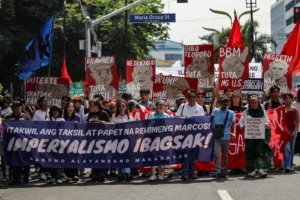
The activity began on Holy Tuesday, March 31, with a mass and symbolic procession called the “Kalbaryo ng Maralita” (The Calvary of the Urban Poor) in a community along NIA Road in Quezon City. Over 200 leaders and members of Kadamay, together with church workers, gathered in the area. Their protest held the Marcos regime accountable for unstable housing conditions, demolitions, and lack of basic community services, especially after a major fire struck the same community last year.
They also raised the issue of the SDG Park project’s planned eviction of urban poor communities within the University of the Philippines in Diliman, and threats to livelihood, security, and shelter in Area 17, Pook Aguinaldo, and Pook Malantik.
Similar activities were held in communities in Tondo, Caloocan, Malabon, and Navotas, as well as at Welcome Rotunda and Tatalon in Quezon City. Manila health workers and residents held the “Kalbaryo ng Manggagawang Pangkalusugan at Mamamayan” (The Suffering of Health Workers and the People) at the Department of Health. They highlighted the soaring prices of medicine and the worsened difficulty of getting hospital care.
In Davao City, the “Kalbaryo sa Katawhan” (Calvary of the People) took place at Freedom Park. Led by Bayan–Southern Mindanao and Kadamay–Davao, participants condemned the relentless rise in oil prices, the government’s inaction on poverty, and rampant corruption.
“The people’s calvary is not merely a religious ritual but a mirror of the real suffering the poor endure every day,” Kalipunan ng Damayang Mahihirap (Kadamay) secretary general Mimi Doringo said. “The masses continue to bear the weight of high oil prices, demolitions, and the lack of decent housing and work.”
Kalbaryo ng Mamamayan is an annual activity that joins faith and struggle. For its organizers, personal repentance is not enough; ending systematic suffering requires collective action.
At the close of Holy Week, the groups urged the government to address urgent demands on housing, wages, and commodity prices. “Our journey is collective. We fight together in difficult times,” a protest participant said.