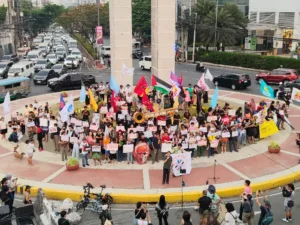

Alyansa ng Manggagawang Bukid ng Asyenda Luisita (AMBALA) newly elected officers took their oath in a gathering held in Barangay Lourdes, San Miguel, Tarlac City on November 16. The event coincided with the marking of the 2004 massacre where state forces shot and killed seven farmworkers.
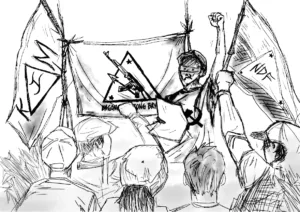
At the gathering, participants raised their fists to honor Jun David, Adriano Caballero, Jhaivie Basillo, Jesus Laza, Jaime Pastidio, Juancho Sanchez, and Jessie Valdez. At that time, the United Luisita Workers Union and the Central Azucarera de Tarlac Labor Union had gone on strike in response to the illegal dismissal of 326 unionists. The strike also opposed the company’s slave wages, which then dropped to ₱9.50 per day.
Aside from honoring the strike’s martyrs, the farmers also recognized those killed by police and military forces over more than two decades of struggle.
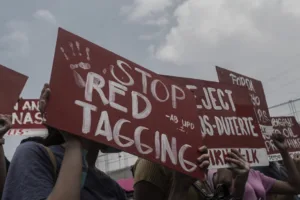
Concluding the program, they tore up canceled Certificates of Land Ownership Award (CLOA). They said this act symbolized their resistance to land grabbing, referring to land that had long rightfully belonged to them. Carrying their demands for land rights, livelihood, and housing, they marched across the city afterward.
Assembly on the anniversary’s eve
Ambala elected its new officers at its assembly on November 15, the eve of the massacre’s anniversary. Leaders and members from different barangays participated in the event. The new Ambala officers now bear the responsibility of reclaiming the victory of the people’s strike and revitalizing and strengthening the organization.
Farmer-leaders from the Kilusang Magbubukid ng Pilipinas (KMP), Amihan-National Federation of Peasant Women, and Unyon ng mga Manggagawa sa Agrikultura (UMA) attended the assembly as guests.
KMP chairperson Ka Ronnie Manalo discussed the national situation of farmers and its link to bureaucrat capitalism. Amihan’s Cathy Estavillo highlighted the conditions of peasant women and the vital role of their movement in the peasant masses’ struggle. This discussion was especially significant since most of Ambala’s newly elected officers are women.
Land grabbing and violence
Meanwhile, UMA chairperson Ariek “Ka Ayik” Casilao linked the denial of land to farmers with the collusion between landlords and bureaucrat capitalists.
He stated that the deprivation of farmers of their land, as seen in the hacienda, is linked to corruption. Landlords use the state to maintain their control over land. Worse still, they use the same state to suppress farmers fighting for their rights.
This situation is evident in the case of Hacienda Luisita, where the Cojuangco-Aquino clan that seized the land also occupied positions in the state and ordered the violent dispersal of the strike in 2004.