
Every year, as super typhoons batter the Philippines, millions of Filipinos brace themselves for devastating floods. In the low-lying communities of Metro Manila, Central Luzon, and coastal areas of the Visayas, muddy floodwaters engulf entire streets and homes, destroying livelihoods along the way. Behind this recurring hardship of inundated communities and displaced families lies the deliberate exploitation of so-called “flood control funds” by corrupt politicians.
Flooding in the Philippines is more than just natural disasters. It is a symptom of bureaucrat capitalism, where politicians run the government like a business, enriching themselves by funneling public funds into their own pockets. Under Marcos Jr., flood control projects have become among the most corruption-ridden sectors of public works, lining the pockets of politicians, contractors, and their cronies while leaving the masses perpetually submerged in floodwaters.
In 2024 alone, the Department of Public Works and Highways (DPWH) allocated over P200 billion for flood control projects, outstripping even road construction funding in some regions. At first glance, this seems like a rational response to worsening climate impacts, but digging deeper reveals that flood control projects have consistently been the most padded, anomalous, and politically manipulated infrastructure programs within the reactionary state.
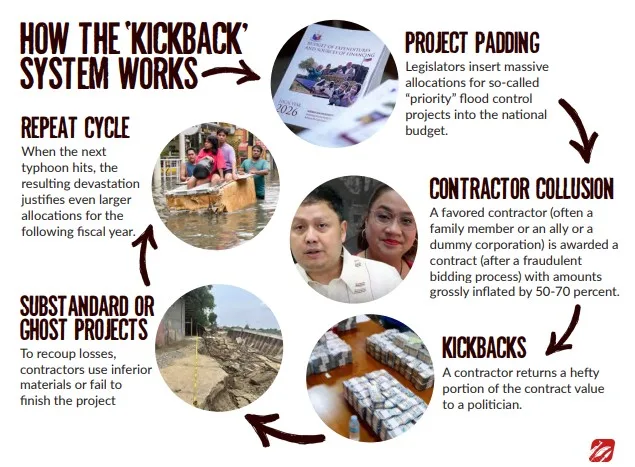
- Project padding – Legislators insert massive allocations for so-called “priority” flood control projects into the national budget.
- Contractor collusion – A favored contractor (often a family member or an ally or a dummy corporation) is awarded a contract (after a fraudulent bidding process) with amounts grossly inflated by 50-70 percent.
- Kickbacks – A contractor returns a hefty portion of the contract value to a politician.
- Substandard or ghost projects – To recoup losses, contractors use inferior materials or fail to finish the project
- Repeat cycle – When the next typhoon hits, the resulting devastation justifies even larger allocations for the following fiscal year.
The kickback system in Philippine flood control projects typically follows a predictable pattern: a flood control project is first proposed, often by a congressman or a local politician eager to showcase “deliverables” to their constituency. The project is then inserted into the DPWH budget, sometimes via legislative inserts or last-minute additions during budget deliberation, with minimal technical specifications. The contract is fraudulently awarded to a firm linked to the politician or to one willing to share the profits. Even before the work begins, a “commission” or kickback is negotiated, usually as fixed percentage of the contract price (between 20-30%), or through a complex set of charges including bribes to the bidding committee, revenue for the congressional representative, cut for the contractor, and shares for DPWH officials or district engineers.
Funds would often be released in cash through the government-controlled Land Bank of the Philippines, deliberately structured to avoid leaving a digital money trail. Once withdrawn, the cash was handed over to contractors or middlemen, who then distributed kickbacks to politicians and DPWH officials. To cover the tracks, receipts, vouchers, and liquidation documents were routinely forged, creating the appearance of legitimate disbursements even for projects that were substandard, incomplete, or never built at all.
By the time the funding reaches the community level, it has often been slashed by around 30-40%, resulting in substandard construction materials. Some so-called ‘ghost projects’ were never built at all, despite being reported as completed. Once a project is declared “completed” on paper, funds are released, and the kickbacks are distributed in cash. The result is often substandard or poorly maintained infrastructure or, in many cases, nothing at all for communities promised protection from rising waters.
[INFOGRAPHIC – Billions lost due to corruption under Marcos Jr.]
- P545 billion allocated for flood control from 2022 to 2025, covering a total of 9.855 projects.
- 15 contractors cornered about 20% of the entire P545 billion budget.
- 6,000 projects worth P350 billion lacked key details or had duplicate contract costs across different locations.
- P42.3 billion – 118.5 billion lost annually (2023-2025) due to ghost projects, cost inflation, substandard construction, and related issues.
Even before Marcos Jr.’s term, the Commission on Audit (COA) had already raised red flags over defective, delayed, or mismatched flood control projects as early as the late 2010s including during Duterte’s term, particularly from 2017 to 2020. In 2019, anomalies were exposed, alleging around P332 billion in questionable flood-control allocations in the national budget. More recent investigative reports revealed that a small group of just 15 contractors dominated flood-control project awards, cornering P100 billion out of the total P545 billion in public funds since 2019, a pattern of control that persisted into the Marcos Jr. years.
Under Marcos Jr., the pattern not only continued but escalated. By 2023, the flood control budget had swelled to P183 billion, nearly a quarter of the DPWH’s entire infrastructure allocation. Investigations revealed that up to 70% of the total budget was lost to corruption.
Since Marcos Jr. became president, an average of about 200 people have died annually from weather-related disasters, including floods. For example, typhoon Agaton which hit Western Visayas in 2022, killed 187 people–-especially striking given that billions had already been spent on flood control projects in the region at that time. In 2023, regions like Bicol and the Cordilleras were struck by typhoons Egay and Falcon, causing at least 25 and 30 deaths, respectively. In 2024, typhoons Kristine and Leon left dozens dead across various regions despite billions being spent on flood management projects, once again highlighting the disconnect between funds deployed and lives lost.
Indeed, the rot of bureaucrat capitalism runs deep. In a semicolonial and semifeudal society such as in the Philippines, the ruling cliques treat political positions as investments with clear expectations of returns. Politicians pour millions into their electoral kitty funds to secure government positions, and once elected, they milk the people’s coffers for their “returns.” Flood control projects, funneled through pork-barrel-like allocations and last-minute congressional insertions during budget deliberations, have become key revenue streams for the corrupt.
The Philippines’ flood control projects expose the true nature of bureaucrat capitalism: parasitic, corrupt, and anti-people. Behind every collapsed dike and every displaced family lies a system that thrives on disaster.
But when the waters rise, so too must the people. Against bureaucrat capitalism, against imperialist plunder, against the rotten system that profits from disaster—the Filipino masses must and will rise, like the floods: raging and unstoppable.