
In the spring of 2023, the three of us landed at the Ninoy Aquino International Airport in Manila and our two and a half month long ‘integration trip’ organized by the Communist Party of the Philippines (CPP) began. During this time, we had several hosts and got insights into a wide range of social situations. After waiting a few weeks, we got the chance to stay in a temporary camp of a guerrilla unit for 16 days before integrating in a community of fisherfolks dealing with the consequences of profit-driven ecocide while engaged in legal battles with Chinese corporations intending to build luxury resorts on their ancestral lands.
Growing increasingly impressed by the organizational capabilities of the CPP, we got a comprehensive view of the Filipino people’s struggle at every station of our journey. Below I reminisced about the experiences we had with those who most selflessly devoted themselves to serve the people: the Red fighters.
After a moonless, pitch-dark night of marching single file through the densely forested hills of one of the 7,641 islands that make up the archipelagic country, our group arrived in a camp of a New People’s Army (NPA) platoon early one morning, towards the end of the dry season. The only sign of its existence were a few cut branches in the thicket through which we stumbled, and we only realized that we’d arrived when we stopped in the middle of the encampment. With our rubber boots soaked from wading through rivers and having been drenched in sweat, we found ourselves in a large pavilion made from cut down trees and tarpaulin. This construction was referred to as the ‘school’, complete with a lectern, flags displaying hammer and sickle or a rifle and spear, and welcoming faces. Then, as soon as we’d put down our backpacks and poured the muddy water out of our boots, the kasamas (the Filipino word for ‘comrades’) assembled to greet us with a kapehan, a coffee break where everyone was introduced and songs were sang. Hearing the hushed voices of the kasamas singing acapella, in unison with the birds, permitted us to finally relax. This moment of serenity was timely and reinvigorating since the exhausting march wasn’t seamless. Crossing a highway, we encountered a convoy of Armed Forces of the Philippines (AFP) trucks transporting soldiers, which, luckily, did not spot us lying in the bushes next to the street. Nonetheless, this short intermezzo with the comrades aiming their guns and the palpable tension mixing with the nightly fog made us utterly aware of the constant threat of experiencing lethal violence, as well as the uncertainty of when this might occur, which the guerrillas are well prepared for. In the previous months, the company or segments of it, got involved in numerous firefights and the three formations making up the temporary guerrilla forest camp we stayed in, bore the names of martyrs who recently fell victim to the government’s ‘Focused Military Operations’. Fortunately, throughout our stay in the camp, there were no further encounters with any agents of repression, and besides the occasional ‘observation’ of a suspicious sound or movement, upon which silence fell over the camp until an all-clear signal would relieve the tacit tension (“It was a dog” or “There were drums in a nearby village”), the only shooting we were involved in was with our cameras. Thanks to the close monitoring of any military movement in the area, and with comrades updating us during our daily briefings, we always felt safe and well taken cared of. Curiously, the combat stories that were shared with us both reinforced that feeling and kept us on edge as they stirred our imagination of what might emerge from behind the dense foliage which both hid us but also limited our ability to see any approaching threat.
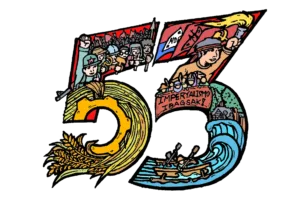
The temporary camp was set up to hold a conference on strategy, conduct internal educational discussions and host us – three internationalists from Europe, and members of local organizations, who were there to experience the celebration of the 50th anniversary of the NDFP. Since we had left our phones in the city for safe keeping, the morning of the event, a G-Shock pastiche wristwatch that was lent to us for the time of our stay, woke us to vestigial darkness. The kubo (a wooden construction usually built and used by peasants to escape the burning midday sun during their work in the fields) we were sleeping in, sat on the hillside of one of the three mounds embracing the ‘school’ and main ‘square’ adjacent to it. On this ‘square’, simply a flat area which was freed from trees between the two streams that ran through the camp, the daily morning exercises took place. Next to an uprooted tree stump which was stuck back into the ground up-side-down, now functioning as a gun holder, sat a flock of chickens. After waking us with their loud protests over being transported in rice sacks during the night, the white-feathered birds now sat quietly, oblivious to their fate as dish for the celebration.
For breakfast, everyone (except for me due to my medical condition, I was provided with a specially cooked vegetarian meal) had rice and tinapa (small smoked fish). As soon as the plastic containers, which was used to distribute the food to the different positions, were gathered and washed again, the preparations for the anniversary gained momentum. In the ‘school’ some of the kasamas started to set up the stage. An NDF flag, hand-sewn and decorated with letters cut from yellow paper, was hung behind the lectern. Next to it was a banner made of tape, displaying the 12-point program. It would later be covered in slips of paper, as every participant of the event stuck a small note with their renewed vow to uphold the organization’s principles after their speech or performance. I was handed some pieces of colorful chalk and tasked with drawing the logos of the different NDFP allied organizations on a black tarpaulin under the guidance of the propaganda officer. Since I’d never drawn on a free-hanging tarpaulin before and struggled to get the proportions right, I was soon relieved of this duty. Next to us, a few comrades forming the ‘cultural group’ Pulang Bandila (‘Red Flag’) were quietly rehearsing their choreography with flags, bolos and their M16 rifles as props. For the special occasion and to regain some energy, the camp commander prepared pancakes, which were distributed together with sugary coffee as the setting-up finished. A short time later, everything was ready, and the energized kasamas all assembled, and the ceremony started.
After a short introductory speech by two of the younger comrades in the gathering, Ka Aiko a clean-shaven, tall and well-articulated man in his forties stepped up to the lectern and read a statement of exaltation to the martyrs of the revolution. He began by informing everyone present how Ka Laan, Ka Bagong Tao, and eight other revolutionaries (also known as the Catbalogan 10) were heinously and brutally murdered by the fascist AFP.
The group were unarmed when they were severely beaten and tortured before they were summarily killed. Then, to cover up their monstrous deeds, the fascists blew up the group’s lifeless bodies in a boat full of explosives. Harnessing the outrage generated, the speaker peaked with a call to “set ablaze and spread the fire of the people’s war,” roused a passionate chant by his peers, and concluded by saying, “Inspired by the memories of Ka Laan, Ka Bagong-tao, Ka Joma, and all great martyrs and heroes of the proletariat and Filipino people, let us give all our energy to shoulder the difficult tasks in advancing the aspirations for genuine freedom, democracy and socialism.” When Ka Aiko finished his speech, which was shortly interrupted when he was overcome with tears and quickly left the lectern to blow his nose, he reached behind his back and grabbed the note stuck there. He read the vow on it and recited a poem he had written especially for this occasion.
Subsequently, another kasama started to relate the nature and history of NDFP. Smiles appeared on the faces of the audience. Summoning the expressed support from the ranks of youths, women, church people, scientists, lawyers, artist, writers, teachers, national minorities, peasants and fisherfolks, which form the national democratic alliance, she emphasized that their duty as “organizers in the countryside”, first and foremost is to implement the NDFP’s vision for national liberation and democracy. She stirred laughter by sharing an anecdotal remark: “That won’t happen, comrades, if we don’t promote it ourselves. The masses say the revolution has been around for a long time and ask, ‘When will it happen?’ The comrades reply, ‘When will you join us?’”
After the last speech was wrapped up, a variation of the ‘21-gun salute’ was performed. The spatial limitation of the ‘square’ just allowed for a row of seven kasamas, and due to the camps’ proximity to streets and villages, there was no live firing, only the racking of slides and the hammers hitting empty chambers reverberated. Concluding the anniversary celebration, the kasamas adjusted their stance to face the CPP flag fluttering high on a pole and quietly sang ‘The International’ in Filipino.
As we observed during our time in the Philippines, the people’s democratic revolution has persisted for more than half a century across the archipelago, and it reaches far beyond its shores. The call to join the revolutionary movement, therefore, extends to comrades across the globe. In the face of the ever-worsening crisis of the capitalist world system, our comrades’ unwavering revolutionary commitment continues to motivate all those who seek fundamental change. Contrary to the reactionary government’s claim that Philippine revolution is nearing its end, our experience proves otherwise: It is very much alive, and as strong as ever. We are grateful to comrades who shared their revolutionary experiences and knowledge with us, helping us better understand how the people’s democratic revolution in the Philippnes can inspire resistance abroad. #