
NOTE: This is an excerpt from the full tribute article which can be accessed via josemariasison.com
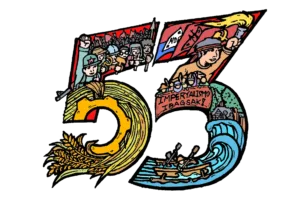
Jose Maria Sison, or as many of you knew him, Ka Joma, was born from one of the richest families in Cabugao, Ilocos Sur, the sixth of seven surviving children, on February 8, 1939. Today would have been his 87th birthday.
In its tribute to Joma, the CPP Second Congress called him “the torch bearer of the international communist movement. … and stated that with the “treasure of Marxist-Leninist-Maoist work that Ka Joma has produced over the past five decades of revolutionary practice, the Party is well-equipped in leading the national democratic revolution to greater heights and complete victory in the coming years.”
Let me sum up Joma’s ideological, political and organizational achievements. He adopted the fundamental principles in the three components of Marxism—materialist philosophy, political economy and scientific socialism—as laid down by Marx and Engels and applied these on the concrete conditions of his own country.
By following Lenin’s identification of the law of the unity of opposites, as the most fundamental of the laws of contradiction, he deepened our understanding of the law of materialist dialectics. From Mao Zedong, he learned how social practice encompasses production, class struggle and scientific experiment as the source of correct ideas. He learned the dialectical relationship between knowledge and social practice; as well as that of perceptual and rational levels of knowledge in the process of cognition.
He learned from all our great Marxist predecessors that in general, the forces of production are primary to the relations of production; and the mode of production is primary to the superstructure. But in the process of sustained revolutionary change, the resulting relation of production and superstructure can play the primary role. The former releases the forces of production from the old fetters and the latter enhances the mode of production.
He taught us what he learned from his Marxist predecessors that class character is determined not only by the ownership of the means of production, the role in the production process and the distribution of the social product but also by the mode of thinking by which social production is carried out. He understood and taught us the dialectical relationship between social being and social consciousness and laid stress on the need for us to continually revolutionize our consciousness through the process of cultural revolution.
He defined culture as the reflection of economics and politics, with which it has a dialectical relationship. In art and literary theory, he called for the reflection of the revolutionary class struggle and for revolutionary workers, peasants and soldiers to be depicted as heroes. He practiced revolutionary romanticism in writing poetry and declared that art and literature are indispensable methods for educating the masses.
He was inspired by the teachings of his great predecessors, regarding historical materialism, particularly the state and revolution in class society. He passionately espoused the revolutionary essence of Marxism; asserting that the proletariat must wage class struggle, seize political power, and establish the socialist state as a class dictatorship of the proletariat against the bourgeoisie.
In revolutionary practice, he stressed the importance of the concrete analysis of concrete conditions, social investigation and mass work, combatting all forms of idealism, subjectivism and “Left” and Right opportunism and taking the mass line in order to transform correct ideas into a material force.
He acquired a deep understanding of the critique of capitalism and outline of scientific socialism by Marx and Engels as well as the critique of monopoly capitalism or modern imperialism and the realization of socialist revolution and construction by Lenin and Stalin.
He extended and further developed our knowledge of Marxist political economy and scientific socialism by studying and the positive and negative lessons from building socialism in the Soviet Union, by leading the criticism and repudiation of Lavaite revisionist renegades in our country in the first rectification movement in preparation for the reestablishment of the Communist Party of the Philippines in 1968 on the theoretical foundation of Marxism-Leninism-Maoism.
He was guided by the teachings of the great Lenin regarding the building of the Communist Party as the advanced detachment of the working class. He introduced the rectification movement as the method for ensuring the ideological, political and organizational strengthening of the proletarian revolutionary party.
He pursued the theory and strategic line of protracted people’s war that guides the revolutionary forces in various forms of armed struggle. He led the Party to engage in the revolutionary united front to arouse, organize and mobilize the people in their millions for the armed revolution. At the same time, he ensured the vanguard role, independence and initiative of the working class party. He advocated the building of organs of political power at various levels—barrio, municipality, province and upward—to constitute the people’s democratic state.
He led our Party and other revolutionary parties worldwide to stand for socialism and repudiate modern revisionism by exposing the degeneration of the Soviet Union from being socialist to being monopoly bureaucrat capitalist with a general tendency towards social-fascism; by opposing the neocolonialism of the two superpowers, US imperialism and Soviet social imperialism and most important of all by waging the Philippine revolution self-reliantly and in the spirit of international solidarity and proletarian internationalism.
He integrated the universal theory of Marxism-Leninism-Maoism on the concrete semicolonial and semifeudal conditions of the Philippines under the class leadership of the proletariat within the context of the world proletarian-socialist revolution and by doing so, we can be proud of him as a great Communist thinker and leader.
Ka Joma lives on in the perseverance of the revolutionary forces and masses in the struggle against imperialism and all reaction. Let us carry on his legacy by winning the battle for democracy to open the gates to socialism. Let us build on the strong Marxist-Leninist-Maoist foundation that Ka Joma helped build with his works and deeds and advance the people’s epic—the revolutionary movement as an endless movement of strength.