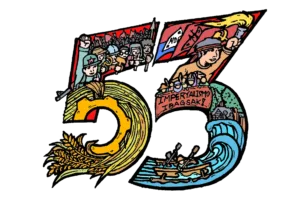

For more than half a century, the people’s war waged by the New People’s Army under the absolute leadership of the Party has stood as a defining force in the just struggle of the Filipino people for national and social liberation. Now marking its 57th year, the NPA stands firmly rooted in the daily struggles of the masses who continue to bear the brunt of the ever-worsening crises of a semicolonial and semifeudal Philippine society.
At its heart, the NPA addresses the basic demands of the peasantry for free land distribution. By advancing the interrelated aspects of agrarian revolution, mass base building and developing the armed struggle, the NPA charts the correct path toward genuine national sovereignty and social justice for the Filipino people.
Central to these efforts is the worker-peasant alliance forged under the leadership of the Party. By relying mainly on poor peasants, winning over middle peasants, and neutralizing the influence of rich peasants, the revolutionary movement has been able to isolate and confront the landlord class. This class line has guided the steady advance of the anti-feudal united front in the countryside.
Agrarian revolution remains the main content of the national democratic revolution. Depending on what conditions allow, the NPA has carried out both minimum and maximum land reform programs. The minimum program includes rent reduction, the elimination of usury, fair pricing for agricultural produce, raising of wages of agricultural workers, and the promotion of production through cooperation and livelihood development. The maximum program pushes further by confiscating land from landlords and land grabbers and redistributing it free to the tillers, alongside the gradual and step-by-step development of agricultural cooperation.
The NPA plays a significant role in ensuring that these gains are defended. The NPA prevents landlords and the reactionary state from reversing the victories of agrarian evolution, dismantles large landholdings seized by corporations and bureaucrat capitalists, and supports the redistribution of ancestral lands to national minorities. It also enforces policies of the people’s democratic government, particularly against projects that displace farmers, reduce arable land, or harm the environment.
Through the advance of the people’s war, organs of political power have been established across the countryside. Beginning at the barangay level, organizing committees are transformed into elected revolutionary bodies that form the backbone of the people’s democratic government. These organs represent workers, peasants, and Party cadres, and they oversee governance in areas such as education, production, health, environmental protection, dispute resolution, and community defense.
In this process of building revolutionary power, participation has drawn broadly from the masses across sectors, including women who take on important roles in organizing, production, and even in the armed struggle itself. Their involvement reflects the wider effort to transform social relations shaped by feudal and patriarchal conditions especially in the countryside. At the same time, programs and policies within the revolutionary movement consciously address all forms of inequality and social injustice that affect different sectors of the people, including those rooted in gender.
In this context, two governments exist in the Philippines – the reactionary state of the ruling classes represented by the US-Marcos regime on the one hand, and the people’s democratic government on the other. Contrary to claims that the revolutionary movement has achieved little in more than five decades of struggle, these organs of political power continue to expand, exercising Red political power over millions and in many areas, compelling even local officials of the reactionary state to cooperate in the programs of the people’s democratic government.
The strength of the revolutionary movement has been forged through struggle. It has withstood the US-Marcos fascist dictatorship, and repeated attempts of post-Marcos regimes to dismantle it through various counterrevolutionary campaigns directed and supported by US imperialism.
The Philippine revolution has gained widespread recognition and solidarity. The people’s army in particular enjoys the support of other movements and support networks abroad. Overseas Filipinos, in particular, play an important role in amplifying the struggle, contributing to mass work and strengthening international ties with progressive organizations and movements.
In the broader global context of intensifying imperialist rivalries, wars, and systemic crises, the Philippine revolution positions itself as part of the wider struggle for national liberation, democracy, and socialism. Its persistence reflects not only its internal strength but also the continuing relevance of its analysis in a world marked by deepening inequality and exploitation.
Celebrating the 57th anniversary of the NPA takes stock of the great achievements of the national democratic revolution through protracted people’s war, to honor the Red fighters and commanders, the revolutionary heroes and martyrs, and especially the toiling masses of workers and peasants. Most importantly, it inspires the entire revolutionary movement, the people’s army and all other revolutionary forces and the people to continuously frustrate and eventually defeat the enemy towards the total victory of the people’s democratic revolution.
The crisis of the ruling system, both domestically and globally, continues to worsen, intensifying the conditions that give rise to people’s armed resistance. As long as imperialism, feudalism, and bureaucrat capitalism persist, the grounds for revolutionary struggle remain fertile. These same conditions of poverty, landlessness, unemployment, and foreign domination underscore the continuing necessity of the people’s war.
After 57 years, the New People’s Army endures and advances because it responds directly to the needs and aspirations of the Filipino people. Firmly rooted in the masses, the NPA continues to raise high the banner of revolutionary armed struggle aiming toward the realization of a Philippines that is truly independent, democratic, prosperous, socially just and progressive.