
In the early hours of a November morning, the quiet rhythm of daily life in the coastal barangay of San Vicente was broken by the sudden roar of low-flying helicopters. The sound echoed off the hills and rice fields, rattling tin roofs and waking children from their slumber. On the ground, farmers stopped mid-step, wide-eyed and disoriented. Mothers clutched their children. The elderly whispered prayers under their breath.
Para kaming binomba pero walang giyera (It felt like we were being bombed, but there was no fighting). The choppers flew so low that we could see the faces of the soldiers. They were not Filipino, but American soldiers. No one told us they were coming. There was no warning, no explanation. We did not know if there was already a war or if it was just a drill. All we had was fear for our lives.
Recalls Ate Lina, a 44-year-old coconut farmer and mother of three.
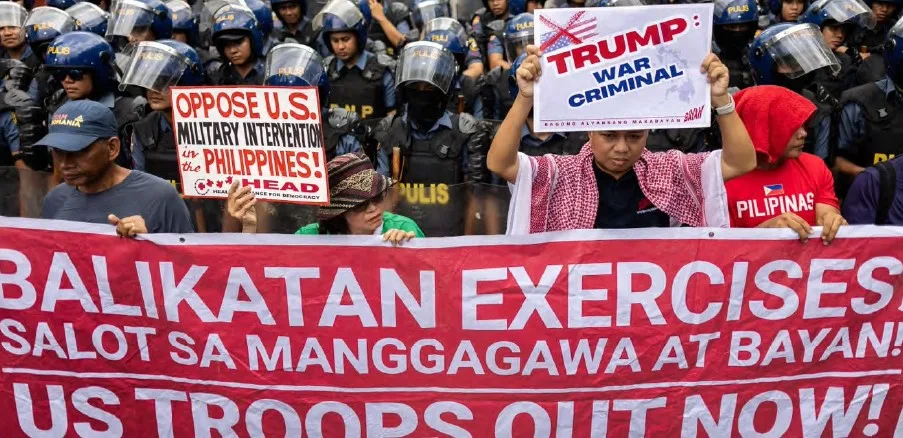
It was part of Balikatan: the annual joint US-Philippines military exercise which has been intensifying in recent years. But for communities like Ate Lina’s, these war games are not just military drills. They are an invasive, disruptive and disorienting series of events. An imperialist power’s military rehearsal to provoke China into a hot war, unfolding in their literal backyards and right before their very eyes.
San Vicente is home to an island somewhere at the tip of Luzon, a lush marine reserve and ancestral domain of the Agta indigenous communities. It is also now the site of increased US and Philippine military activity, including surveillance flyovers and amphibious landing drills.
“There was no consultation. No barangay meeting. No written notice. Nothing,” says Mang Jun, a barangay tanod in the nearby village of San Vicente Norte. “We only knew about what was happening when the helicopters came, and even then, we had to piece together information from the radio.”
When local leaders tried to raise concerns, they were ignored, or worse subjected to surveillance and harassment. “Since last year, we’ve seen new faces around town. Men asking discreet questions about us, soldiers dressed in civilian clothes. We’re afraid to speak. If you criticize anything, they say you’re a sympathizer of the New People’s Army,” he adds, referencing the increasing red-tagging in the area.
For the fisherfolk of San Vicente, the sea has always been life. But during the Balikatan exercises, it became a stage for war games. US soldiers reportedly paid fishermen around $400 to rent their homemade bangkas, or wooden fishing boats, for amphibious drills.
Mang Dado, a 52-year-old fisherman, initially agreed. “Akala ko tulong na ‘yon. Malaking halaga din kasi ‘yon para sa amin (I thought it was help. That’s already a big amount for us),” he says. “But when I saw soldiers with rifles boarding my boat, using it in mock battles…something inside me twisted. It was no longer just a boat. It became part of something we didn’t understand.”
After the drills, Dado’s boat came back with damaged outriggers. “They gave me money, but now I can’t fish properly. And what if our area becomes a real target? What if it’s no longer a drill anymore? What if someone thinks we are part of the military now? We feel vulnerable.”
In nearby barangays, reports have emerged of soldiers requesting to store equipment in civilian homes and buildings from churches, schools, and even abandoned warehouses – far from the designated EDCA (Ehanced Defense Cooperation Agreement) sites. Many residents fear these are not humanitarian supplies, but ammunition and weapons, stored close to homes without any legal basis or warning.
“They asked to store boxes in our community hall,” shares Aling Nene, a barangay health worker. “They said it was just for relief goods. But the boxes were locked, heavy, and guarded. We suspect they are weapons…because why hide food?”
The EDCA agreement requires that US military materials be confined to designated sites. But in San Andres, locals say the rules are “quietly broken” and the Philippine government was nowhere to be found.
During the April 2024 round of Balikatan, large coastal areas along Northern Luzon were declared off-limits to civilians, including vital fishing and farming grounds. In exchange, residents were given “aid” in the form of a few sacks of rice and canned goods that did not even last a full week.
Rosalie, a 27-year-old mother of two, says her husband was unable to fish for nine days during the military drills. “Wala kaming kita. Wala kaming panggatas para sa mga anak namin. Tapos bigas lang ang kapalit (We had no income. We could not buy milk for our children. And all they gave us was rice.),” she says. “Are we supposed to thank them for starving us less?”
Back in San Vicente, the silence is heavier than the sound of Black Hawk helicopters. It lingers in the conversations cut short. In the meetings never held. In the questions never answered.
“They didn’t tell us what was coming,” Ate Lina utters to herself. “They didn’t ask if it was okay. They just came. And now we live with the consequences.”