
Since the flood control project scandal erupted in August, anti-corruption protests have surged across the Philippines demanding full accountability of all involved, all the way to Marcos Jr, the Lord of Thieves.
In his July 28 State of the Nation Address, Marcos Jr projected a strong stance against corruption, ordering an investigation into anomalous Department of Public Works and Highways (DPWH) flood control projects. Yet, these proclamations amount to little more than window dressing, largely failing to translate into swift and decisive actions.
Subsequent probes by the Senate, House of Representatives, and the Marcos-appointed Independent Commission for Infrastructure (ICI), headed by Rogelio Singson, have yielded dismal results, despite strong public clamor for accountability. Ironically, Singson recently resigned, citing insufficient funding and limited authority.
So far, eleven DPWH (Department of Public Works and Highways) officials involved in a ₱289-million anomalous flood control project in Oriental Mindoro have been arrested. The Discaya couple, who are at the center of the controversy over their firms bagging billions in flood control contracts, have been charged with graft and malversation. Likewise, DPWH officials Brice Hernandez and Henry Alcantara face similar charges but have filed applications to become state witnesses.
Meanwhile, the biggest thieves like Zaldy Co, Martin Romualdez, and their master Marcos Jr, remain untouched despite strong evidence of embezzling billions of public funds through budget insertions. This reeks of systemic impunity fueled by bureaucrat capitalism.
Hence, the progressive mass movement’s call, “Lahat ng Sangkot, Dapat Managot” (Everyone involved must be held accountable), has resonated widely, surging from small ripples of protest actions to bigger waves of mobilizations.
In early September, activists from Kalikasan, an environmental group, and a group of disaster and flood survivors trooped to Discaya-owned St. Gerald Construction in Pasig, Metro Manila. They threw mud at the company gate and spray-painted words such as “magnanakaw” (thief), “kurakot” (corrupt), and “ikulong” (jail) on its walls and fence.
On September 5, Makabayan-led progressive groups rallied outside the House of Representatives as lawmakers deliberated the 2025 DPWH budget, while Bayan-Cebu activists threw tomatoes at DPWH logos and markers.
In the weeks before September 21, local indignation rallies and symbolic actions were organized nationwide.
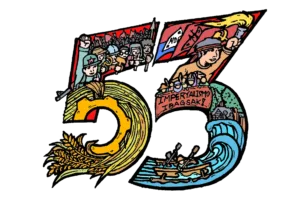
On September 21, the first wave of major mobilization saw a massive outpouring of protesters. In Manila, Kilusang Bayan Kontra Kurakot (People’s Movement Against Corruption) led the Billion Peso March or Baha sa Luneta, drawing over 100,000 participants demanding accountability and an end to corruption and political dynasties. The event also coincided the 53rd anniversary of Martial Law, the darkest period in the Philippines, when Marcos Sr. placed the entire country under dictatorship for 13 years.
A second wave built up in October and November, culminating on November 30, Bonifacio Day. Dubbed Baha sa Luneta 2.0, Kilusang Bayan Kontra Kurakot once again drew multitudes to Luneta, this time also calling for the resignation of Marcos and Duterte.
These waves of mobilization took place nationwide and abroad, peaking at tens of thousands of participants overall. For instance, hundreds of Filipinos in the US, Australia, New Zealand, several countries in Europe and Asia, led by BAYAN staged various protests on both occasions.
On December 10, International Human Rights Day, Makabayan-led anti-corruption activists marked the occasion by emphasizing that flood control corruption is a human rights issue. The government acknowledged that the country has lost approximately ₱42.3–₱118.5 billion (US$713 million–$2 billion) annually since 2023, funds that could have been used to support social services. Protesters once again echoed their call: “Lahat ng Sangkot, Dapat Managot!”