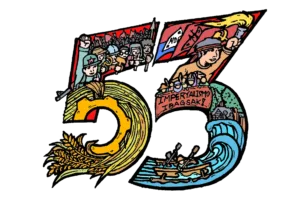

The National Democratic Front of the Philippines (NDFP) successfully held its Sixth International Theoretical Conference on Fascism and Imperialism in the 21st Century in the Neocolonies last May 22–23 in Kathmandu, Nepal, bringing together nearly 200 participants from 17 countries across five continents.
The two-day gathering marked the sixth installment in the NDFP’s series of international theoretical conferences aimed at bringing together proletarian-socialist parties and anti-imperialist groups to share their analyses of the contemporary situation of imperialism.
“In the neocolonies, the rise of fascism is intertwined with the formation of the coercive state imposed by imperialism, in collusion with local big bourgeois comprador interests, to carry out unimpeded semifeudal extraction and suppress national resistance,” emphasized the Communist Party of the Philippines in their keynote speech differentiating it from how fascism emerges in the imperialist centers.
Centered on the theme of fascism in the neocolonies, the conference deepened participants’ theoretical and historical understanding of fascism as a class phenomenon rooted in the contradictions of imperialism. Discussions examined how fascism has developed and adapted in the 21st century, particularly within countries subjected to neocolonial rule and imperialist intervention.
“In the Philippines and in other countries with active armed liberation struggles, fascism is expressed primarily in the form of counterinsurgency operations modelled after the US Counterinsurgency guide,” added NDFP International Representative Marian Espinosa who opened the conference.
The conference drew from the works and experiences of revolutionary thinkers and leaders such as Vladimir Lenin, Joseph Stalin, Georgi Dimitrov, and Mao Zedong, as well as lessons from the Fifth NDFP International Theoretical Conference on fascism in the imperialist heartlands.
A total of 17 theoretical papers were presented and discussed, focusing on the present-day manifestations of fascism in the neocolonies and the specific historical conditions that shape its emergence and character. Participants examined the deepening economic crises confronting working people both in the imperialist centers and across the neocolonial periphery, highlighting how these crises intensify exploitation, oppression, and social instability.