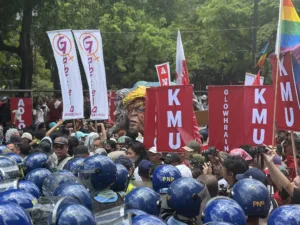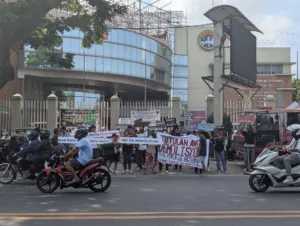

AGHAM National, AGHAM Diliman, and professionals and students under STEM protested on March 25 to denounce the plan to construct a US military-linked nuclear reactor experiment on UP Diliman land. They held the protest at the UP Asian Institute of Tourism in Diliman, Quezon City, where the university’s Board of Regents was then meeting.
The PNRI and Valar entered into an agreement in March 2025 to build a multi-million dollar 100-kilowatt microreactor. The project, called “Ward One,” is led by the Valar Atomics Research Institute, a subsidiary of Valar in the Philippines based in the UP Ayalaland Technohub in Quezon City. PNRI proposed building the reactor on UP Diliman grounds. Not for generating electricity, the small plant will will only be an experiment for the planned construction of commercial reactors in the country. The agreement falls under the 123 Agreement signed by the Philippines and the US in 2023.
“UP is not a testing ground for another country’s nuclear reactor… UP is a testing ground for our own ideas for the benefit and progress of our own nation. We are not a testing group for countries that only wage wars,” National Institute of Physics professor Dr. Giovanni Tapang said.
Valar Atomics was established three years ago by Isaiah Taylor, a businessman and software engineer who had previously worked under the US Defense Department developing technological systems. The company is interested in accelerating the development of its technology by experimenting in countries with lax nuclear energy laws and regulations such as the Philippines. One of Valar’s funders is US weapons and advanced technology manufacturer Anduril Industries.
Valar Atomics’ direct connection with Anduril Technology and the US military reveals the technology’s future use, aligned with the growing US military presence in the Philippines, AGHAM said.
The group emphasized that it opposes the project, not nuclear technology as a whole. It believes that nuclear energy research in a country like the Philippines must first focus on its suitability and necessity given the country’s particular conditions, such as frequent typhoons, numerous fault lines, and active volcanoes.
“Studying and developing nuclear energy in the country requires many years or decades to develop the necessary experts and facilities before building a plant. That is not what is happening under the Marcos regime, which plans to construct a commercial nuclear plant in the middle of a city by 2032 with a company that has no experience in such projects,” it said.
The group joined the growing call within the UP Diliman community for immediate clarification on the status of the Valar Atomic project. It urged the rejection of all US military related nuclear technology and demanded the expulsion of Valar Atomics from the Philippines.